
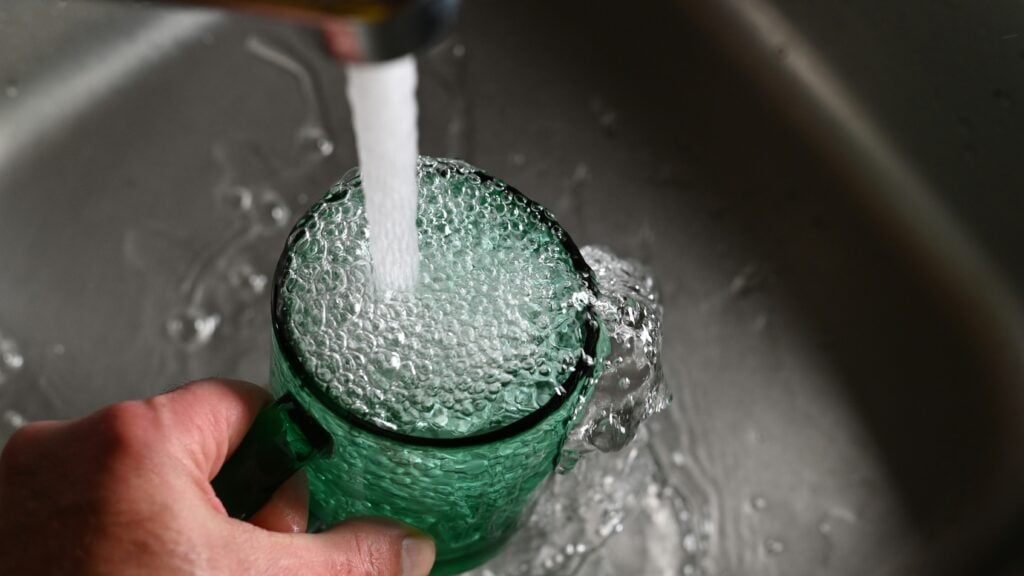
A water softener works through ion exchange. Hard water flows through a tank of resin beads that hold sodium (or potassium). As it passes, the beads grab calcium and magnesium, the minerals that cause hardness, and release sodium in exchange. When the beads fill up, the system regenerates by flushing them with brine, washing the minerals down the drain.
If you live in South Central Pennsylvania, you’ve probably seen the evidence: white crust on faucets, spots on glasses, and scale on the heating element in your water heater. This guide explains what’s happening inside a softener, how it cleans itself, which types exist, and what to know before you get one installed.
Key Takeaways
- A softener doesn’t filter hardness out. It trades calcium and magnesium for sodium or potassium using resin beads.
- It cleans itself through a regeneration cycle that flushes the captured minerals to the drain. We program metered, demand-based regeneration so the system only regenerates when it needs to.
- Test first. We start recommending a softener at about 3 grains per gallon (GPG), and across our service area we commonly measure 10 GPG and above.
- Resin typically lasts 10-15 years, depending on your water and how the system is set up.
- Softened water adds only a small amount of sodium to a glass of water, and there are easy options for low-sodium diets.
Table of Contents
- What Is Hard Water (and When Do You Need a Water Softener?)
- How Does a Water Softener Work?
- The Regeneration Cycle
- Types of Water Softeners
- Benefits of Soft Water
- How to Choose and Size a Water Softener
- How Much Does a Water Softener Cost?
- Water Softener Salt
- Installation: Professional vs. DIY
- Maintenance
- Troubleshooting Common Water Softener Problems
- Is Softened Water Safe to Drink?
- Why Professional-Grade Matters
- Water Softeners in South Central PA
- Frequently Asked Questions
- Ready to Find Out What’s in Your Water?
What Is Hard Water (and When Do You Need a Water Softener?)
Hard water is water carrying dissolved calcium and magnesium. The minerals aren’t a health hazard, and the EPA has no legal limit for hardness, but they’re hard on your home. When water is heated or evaporates, those minerals come out of solution and leave scale behind.
Signs you have hard water
- White, chalky buildup on faucets and showerheads
- Spots and film on dishes and glassware
- Soap scum on shower doors and tubs
- Soap and shampoo that don’t lather well
- Laundry that feels stiff or looks dull
- Scale on water heater elements, and appliances that wear out sooner
- Reduced flow from scaled-up fixtures
Water hardness scale
Hardness is measured in grains per gallon (GPG) or parts per million (ppm). One GPG equals 17.1 ppm. The USGS classifies hardness like this:
| Classification | ppm (mg/L) | GPG |
| Soft | 0-60 | 0-3.5 |
| Moderately hard | 61-120 | 3.5-7.0 |
| Hard | 121-180 | 7.0-10.5 |
| Very hard | Over 180 | Over 10.5 |
The scale describes the water. Whether you need a softener depends on what the hardness is doing to your home. We start recommending one at about 3 GPG, and in the Lancaster, Lebanon, Chester, Berks, Dauphin, and York County areas we serve, we commonly measure hardness at 10 GPG or above, whether the home is on city water or a private well.
The only way to know your number is to test it. We offer a free water test.
How Does a Water Softener Work?
The heart of every salt-based softener is a tank full of tiny resin beads. The beads carry a slight negative charge, and they’re loaded with positively charged sodium ions. Calcium and magnesium carry a stronger positive charge, so as hard water flows through, the beads hold onto them and release sodium in their place. The water that leaves the tank has had its hardness minerals swapped out, which is why a softener is called a softener: it’s named for the result it produces.
Step by step:
- Hard water enters the resin tank.
- As it flows through the resin bed, calcium and magnesium ions trade places with sodium ions on the beads.
- Soft water exits the tank and flows to your fixtures and appliances.
- Over time, the beads run out of sodium to give up. The system then regenerates (see below) to recharge them.
Parts of a water softener
- Resin tank: Holds the resin beads where the ion exchange happens.
- Brine tank: Holds the salt and water that make the brine used to recharge the resin.
- Control valve: The brain of the system. It directs water through the tank, tracks how much water you use, and starts and runs each stage of regeneration.

The Regeneration Cycle
Resin can only hold so much hardness. Once it’s full, the system recharges it with brine, a concentrated salt solution. The sodium in the brine pushes the calcium and magnesium off the beads, and the rinse water carries them to the drain.
The 5 stages of regeneration
- Backwash: Water flows upward through the tank to loosen the resin bed and flush out sediment that has collected on top.
- Brine draw: Brine from the brine tank is pulled through the resin, swapping sodium back onto the beads. This stage commonly runs 20-35 minutes.
- Slow rinse: Fresh water moves slowly through the resin, finishing the exchange and pushing the brine out. Often another 20-30 minutes.
- Fast rinse: A faster flush rinses away any remaining brine and settles the resin bed.
- Brine refill: The brine tank refills with water so the next batch of brine can form.
A full cycle typically takes about 60-100 minutes, depending on the system’s size and settings. Most valves run it overnight when you’re not using water.
Metered vs. timer-based regeneration
A timer-based softener regenerates on a fixed schedule, whether or not it needs to. A metered (demand-initiated) softener counts the gallons you actually use and regenerates only when the resin is nearly used up. Metered is the default we program, because it avoids wasting salt and water on cycles you don’t need. Dual-tank systems add a second resin tank, so one tank can regenerate while the other keeps supplying soft water.
Do water softeners waste water?
A softener does use water and salt during regeneration, since that’s how the beads get recharged. But a properly sized, metered system only regenerates when the resin is actually used up, so water and salt use track your real consumption rather than a calendar. Oversized timer-based units are the ones that tend to waste both.
Types of Water Softeners
| Type | How it works | Upkeep | Best for |
| Salt-based softener | Ion exchange removes calcium and magnesium | Add salt; periodic service | Most homes, especially those with hard or very hard water |
| Salt-free conditioner | Changes how minerals behave so they’re less likely to form scale; does not remove them | No salt or regeneration | Lower hardness and homes that can’t use salt |
| Dual-tank softener | Two resin tanks, so soft water is available during regeneration | Same as salt-based | Larger households or heavy water use |
| Portable exchange | Resin tanks are swapped out and recharged off-site | Scheduled exchanges | Situations where a permanent install isn’t practical |
When we recommend salt-free: only when hardness is around 8 GPG or lower. Because a salt-free conditioner doesn’t remove the minerals, it’s not the right tool for the very hard water we typically see in this area.
What about magnetic and electronic descalers?
We don’t install them. Magnetic and electronic descalers don’t remove hardness minerals from your water, and removing the minerals is the whole job of a softener. If a product promises softener results without removing anything, be skeptical and ask for independent testing.
Benefits of Soft Water
- Less scale on fixtures, in pipes, and on water heater elements
- Fewer spots on dishes and glassware
- Less soap scum, and soap that lathers better
- Appliances that don’t have to fight mineral buildup
- Protection for your tankless water heater’s warranty (see below)
Tankless water heaters and hard water
Many tankless water heater manufacturers set limits on how hard your water can be. If your water exceeds the manufacturer’s limit, your warranty can be voided. Scale is the number one enemy of a tankless heater’s narrow heat exchanger. Check your heater’s manual, then test your water.
How to Choose and Size a Water Softener
The right size depends on your water’s hardness, how much water your household uses, and what else is in your water. Get your water tested first, because a softener that’s too small regenerates constantly, and one that’s too large wastes salt and water.
If you’re on a private well, iron and sediment can shorten resin life, and if your water is chlorinated, a carbon filter ahead of the softener helps protect the resin.
Want the full sizing breakdown? Read our guide: What Size Water Softener Do I Need? A Comprehensive Guide.
How Much Does a Water Softener Cost?
Cost depends on the system’s capacity, whether you need pre-treatment (for iron, sediment, or chlorine), your installation conditions, and the ongoing cost of salt and service. Because every home’s hardness and water use are different, the most reliable way to get a real number is a free water test and consultation, so the quote matches your actual water.
Water Softener Salt
- Pellets and solar salt are the common choices for brine tanks.
- Potassium chloride is an alternative for people who want to avoid adding sodium. It costs more, binds more tightly to the resin so it’s less efficient, and typically takes about 10% more salt per regeneration.
- Avoid rock salt. It tends to carry more insoluble material that can build up in the brine tank and cause problems.
Installation: Professional vs. DIY
A softener installation typically takes about 3-5 hours and needs a nearby power source, a plumbing connection, and a drain.
A professional installation includes:
- A bypass valve, so you can isolate the softener for service without shutting off your water
- Drain routing that meets the system’s requirements
- Programming to your water test, so the valve’s settings match your actual hardness rather than a generic default
The plumbing, drain, and programming all have to be right for the system to perform. Learn more about our water treatment services and professional installation.
Maintenance
- Check your salt level regularly so the brine tank never runs empty.
- Have the system serviced periodically, including a check of the control valve and brine tank.
- Expect your resin to last about 10-15 years. There are a lot of variables, including your hardness, iron content, and chlorine exposure. Chlorine in city water can cut resin life, and a carbon filter ahead of the softener is the standard protection.
Troubleshooting Common Water Softener Problems
| Symptom | Common cause |
| Water is still hard | Out of salt, a bridge in the brine tank, the system isn’t regenerating, or the resin is worn or fouled |
| Softener isn’t regenerating | Settings, a power problem, or a control valve issue |
| No water in the brine tank | No brine is being made, so regeneration won’t work properly |
| Too much water in the brine tank | A brine refill valve or float problem, or a restricted drain line |
| Hard water shows up occasionally | The system runs out of capacity before its next regeneration |
| Water feels slippery | Normal. Soft water doesn’t leave behind the mineral film hard water does |
If the cause isn’t obvious, we’re happy to take a look.
Is Softened Water Safe to Drink?
For most people, yes. A softener adds sodium in proportion to the hardness it removes: about 8 mg of sodium per liter for every grain of hardness, per NDSU Extension. That works out to roughly 2 mg per 8 oz glass for each GPG.
| Your hardness | Approximate sodium added per 8 oz glass |
| 10 GPG | About 19 mg |
| 15 GPG | About 28 mg |
For perspective, a glass of milk has roughly 100-120 mg of sodium.
If you’re on a low-sodium diet:
- The EPA suggests no more than 20 mg/L of sodium in drinking water for people limited to 500 mg of sodium a day. At 10 GPG, softened water adds about 80 mg/L, so it’s worth a conversation.
- Potassium chloride can replace sodium chloride in the brine tank.
- A reverse osmosis system at the kitchen tap gives you drinking and cooking water without relying on the softener.
- Talk to your doctor about sodium in your water, especially if you have high blood pressure, kidney disease, or a restricted diet.
Adding Reverse Osmosis for Drinking Water
When possible, we recommend installing a point-of-use reverse osmosis system in the basement. This saves space under the kitchen sink, makes servicing easier, and leaves room for a larger storage tank, so there’s more drinking water available at the faucet and refrigerator. If a basement installation isn’t possible, a smaller under-sink system is a good option.
We can match the drinking water faucet to the style and finish of your existing kitchen faucet and mount it on the sink or countertop, depending on your layout. We can also connect the RO system to your refrigerator for purified drinking water and ice.
One tip: even with a fridge connection, it’s worth having an RO faucet at the sink. It fills pitchers and cooking pots much faster than a refrigerator dispenser.
Why Professional-Grade Matters
A softener is only as good as its sizing, its programming, and its service. Look for equipment certified to NSF/ANSI 44, the standard for residential cation exchange water softeners, and have it sized and programmed to your water test rather than a generic setting. A properly installed system, serviced by people who know your water, is what keeps it performing for its full life.
Water Softeners in South Central PA
Much of Lancaster County sits on carbonate bedrock, limestone and dolomite, which the Pennsylvania Geological Survey has studied extensively. Groundwater moving through that rock dissolves calcium and magnesium, which is why hardness is such a common problem across our region.
We serve homeowners in Lancaster, Lebanon, Chester, Berks, Dauphin, and York Counties. Whether you’re on city water or a private well, we commonly measure hardness at 10 GPG and above. City water customers should also know that chlorine used for disinfection can shorten resin life, so a carbon pre-filter ahead of the softener is worth considering.
Frequently Asked Questions
Is it OK to drink and cook with softened water?
Yes. If you’re watching your sodium, use potassium chloride in the softener or add reverse osmosis at the kitchen tap.
Do softeners work with tankless water heaters?
Yes, and they matter. Hardness above a manufacturer’s limit can void the heater’s warranty.
Are salt-free softeners effective?
A salt-free conditioner doesn’t remove hardness minerals. It can help reduce scale in lower-hardness water, and we only recommend one at around 8 GPG or below.
What’s the difference between a water softener and a water filter?
A softener removes hardness minerals through ion exchange. A filter removes things like sediment, chlorine, or iron, depending on the type. Softeners don’t remove chlorine, which passes right through.
Can I use a softener with well water?
Yes. Well water often needs testing for iron and sediment first, since both can foul resin, and pre-treatment may be part of the system.
Does a water softener remove iron or chlorine?
A softener is designed for hardness, not chlorine. Some dissolved iron can be handled, but too much fouls the resin, which is why heavier iron calls for a separate iron filter ahead of the softener.
Ready to Find Out What’s in Your Water?
The best first step is a free water test and consultation. We’ll measure your hardness, check for iron and chlorine, and recommend a system sized for your home, or tell you honestly if you don’t need one.
- A softener trades hardness minerals for sodium or potassium, then recharges itself through regeneration.
- Your water test decides the size, the type, and whether you need pre-treatment.
- A professionally installed, metered system is built to protect your plumbing and appliances for years.
Get started by scheduling your free water test.