
Table of Contents
- Home Water Filtration System Cost at a Glance
- What Is a Whole-Home Water Filtration System?
- What Drives Home Water Filtration System Cost?
- Sediment Filtration: Your First Stage of Protection
- Advanced Whole-House Filtration: Carbon and Specialty Media
- Reverse Osmosis: High-Purity Drinking Water
- Where Water Softeners Fit Into Total Cost
- How Much Does a Well Water Filtration System Cost?
- Ongoing Costs: Filters, Salt, and Maintenance
- How to Choose the Right System for Your Home
- How to Keep Your Home Water Filtration System Cost Reasonable
- How to Get an Accurate Quote for Your Home
- Why South Central PA Homeowners Choose HQ Water Solutions
- FAQ: Common Questions About Home Water Filtration System Cost
- Ready to Find Out Your Home Water Filtration System Cost?
Home water filtration system cost can feel confusing. One quote says $800. Another says $8,000. It is hard to know what is fair, and you just want clean, safe water at a price that makes sense.
Here in South Central Pennsylvania, most homeowners spend between $1,500 and $4,500 for a professionally installed whole-home water filtration system. Your exact price depends on your water, your home, and the type of system you choose.
This guide puts everything in one place. You will see real price ranges, what drives the cost, what well water adds, and what it costs to keep a system running. You will also learn how to get a quote that fits your home instead of a guess.
Quick answer? Most South Central PA homeowners spend $1,500 to $4,500 for a professionally installed whole-house water filtration system. Basic systems start around $800. Well water setups and tough contaminants like PFAS can reach $10,000 or more.
Home Water Filtration System Cost at a Glance
Here is a simple snapshot of the average cost of the most common setups, with equipment and professional installation included.
| Setup | Best for | Typical total cost (including installation) |
| Sediment filter stage | Dirt, sand, and rust. Often the first stage of a larger system. | $300 to $800 |
| Basic whole-house filter | Light sediment and chlorine taste. Often one carbon or sediment unit. | $800 to $1,800 |
| Advanced carbon or specialty media filter | Chlorine byproducts, many chemicals, and taste and odor throughout the home. | $800 to $3,000 |
| Well water treatment package | Iron, sulfur smell, hardness, and bacteria concerns. | $2,500 to $5,500 |
| Premium filtration for tough contaminants | PFAS or PFOA, high iron, or bacteria. | $3,800 to $10,000+ |
| Reverse osmosis (drinking water tap) | The purest water for drinking and cooking at one sink. | $1,000 to $1,600 |
| Water softener | Hard water. Protects pipes and appliances. | New: $2,100 to $2,600. Replacement: $2,000 to $2,400 |
You do not pay these numbers by default. Your water test and system design drive your personal quote.
What Is a Whole-Home Water Filtration System?
A whole-house system, also called a whole-house or point-of-entry system, is installed where water enters your house. It treats the water before it reaches any tap, shower, or appliance. That means clean water at every faucet, not just the kitchen sink.
A point-of-use system, like an under-sink reverse osmosis unit, treats one tap. Many homes use both. A whole-home system protects the entire house, and an RO system gives you extra-pure water where you drink and cook.
One more thing to know. Water softeners are not filters. They are conditioners that remove hardness minerals like calcium and magnesium. They are often part of the package, so we include them in the cost.
What Drives Home Water Filtration System Cost?

Two homes on the same street in Lancaster can pay very different prices. Here is why.
Your water source: city water or well water
City water in places like Lancaster, York, and Harrisburg usually needs chlorine, taste, and hardness treatment. That setup can stay simple, like a whole-house carbon filter with or without a softener.
Well water in rural parts of South Central PA often deals with iron, manganese, sulfur smells, or bacteria instead. It usually needs multi-stage treatment with more controls, which raises the cost.
The problems found in your water
Your water test results matter more than your neighbor’s price. Common issues in our area include:
- Hardness and scale
- Orange or brown iron staining
- Rotten egg sulfur smell
- Cloudy water from sediment
- Low pH
- PFAS or PFOA concerns
Each issue needs a different fix. An iron filter costs more than a simple sediment filter. A PFAS-grade carbon system costs more than a basic carbon tank.
Water problems are common across the state. Penn State Extension reports that about half of the private wells that have been tested in Pennsylvania have at least one water quality problem, and that coliform bacteria show up in roughly half of private wells and springs. That is a big reason a test should come before any price quote.
Your goals
Some homeowners only want better taste and smell. Others want strong protection from contaminants like lead, PFAS, or nitrates.
Size of your home and family
Bigger homes and larger families mean higher water usage. Your system needs enough flow to keep up when several showers, the laundry, and the dishwasher all run at once.
Higher flow often means larger tanks and larger control valves. Sometimes extra units need to be piped in parallel. A water filtration technician will be able to explain the extras you may need based on the size of your home and family.
Type of system and filtration technology
- Sediment and carbon filters: lower cost. Great for taste, odor, and basic particle removal.
- Water softeners: target hard water minerals. Mid-range cost.
- Iron and sulfur filters: use air injection or special media. Mid to higher range.
- Reverse osmosis: most often used for drinking water, though large units can feed the whole house. Higher cost.
- UV disinfection: kills bacteria. Often added to well water systems.
Most South Central PA homes end up with a combination. That might be a softener plus a whole-house carbon filter. Or it might be an iron filter, a softener, and UV on a well.
Installation complexity
Even with the same equipment, no two homes cost exactly the same. Several things change the price of installation:
- Access to the main line: easy access in a basement or utility room usually lowers cost.
- Space for equipment: tight areas need more labor and fittings.
- Drain and power: RO systems, softeners, and some filters need a drain connection and sometimes power.
- Code and safety needs: proper valves, bypasses, and supports protect your plumbing.
Older homes in Lancaster City or small farmhouses with cramped well rooms can take longer to pipe.
Sediment Filtration: Your First Stage of Protection
A whole-house sediment filter is often the first step in a larger system. It catches larger particles as water enters your home, which protects the rest of your equipment and your plumbing.
It helps remove dirt, sand, rust, and other visible debris. This protects fixtures and faucets, extends the life of softeners and RO systems, and keeps pipes and valves cleaner. Replacement cartridges are usually replaced every 6 to 12 months and are affordable.
Advanced Whole-House Filtration: Carbon and Specialty Media
If you want better water at every tap, you move beyond sediment filters to advanced whole-house systems. These use activated carbon and specialty media to reduce or remove contaminants like:
- Chlorine and chloramine
- Chlorine byproducts (trihalomethanes and haloacetic acids)
- Lead and other heavy metals, depending on system certification
- PFAS, PFOA, and PFOS, with the right media and certification
- Volatile organic compounds (VOCs)
- Pesticides, herbicides, industrial chemicals, and solvents
- Taste and odor-causing compounds
Showers feel better. Laundry smells cleaner. Dishes rinse without a strong chlorine odor. It also helps protect fixtures and appliances over time.
Filter media does not last forever. Carbon and specialty media typically need replacement every 3 to 10 years, depending on the size of the system and how many gallons your household uses. Once it is used up, it must be replaced to keep performance high.

What To Look For in Certifications
A filter is only as good as the proof behind it. Independent certification tells you a product was tested for the claims on the box. Here are the NSF/ANSI standards you will see most often:
- NSF/ANSI 42: aesthetic effects, such as chlorine taste and odor.
- NSF/ANSI 53: health effects, such as lead and other health-related contaminants. Since 2019, PFOA and PFOS reduction claims are tested under this standard for carbon-based products.
- NSF/ANSI 58: reverse osmosis systems. PFOA and PFOS claims are also tested under this standard.
- NSF/ANSI 55: ultraviolet treatment systems.
- NSF/ANSI 44: cation exchange water softeners.
Certification is given standard by standard. A product certified for one contaminant is not automatically certified for all of them, so match the certification to the problem your water test found. You can look up certified products in NSF’s online listings.
Looking for a specific fix? See our pages on certified PFOA and PFAS filter systems, lead filters, and iron filters.
Reverse Osmosis: High-Purity Drinking Water
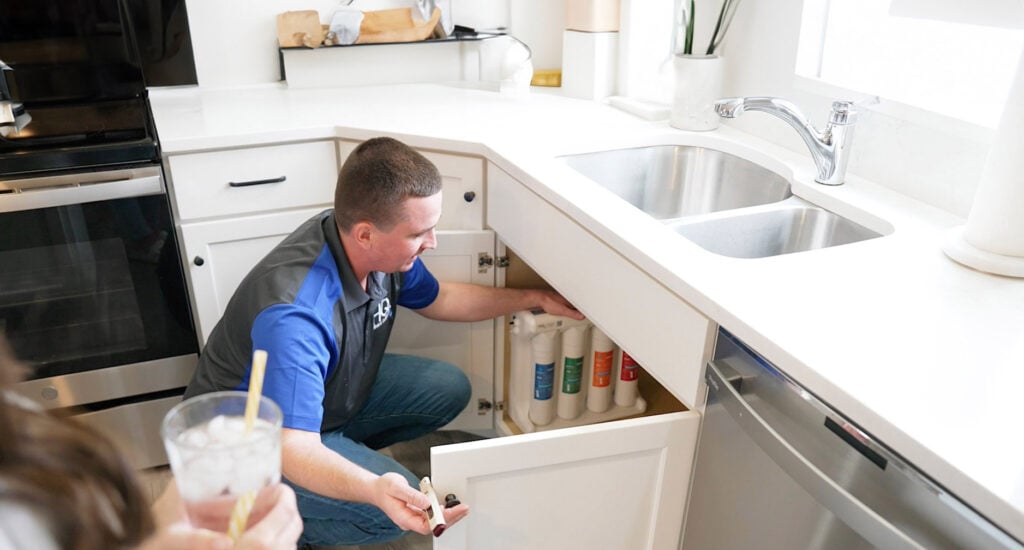
Reverse osmosis (RO) systems are usually installed at one sink, often in the kitchen. They focus on your drinking and cooking water, where purity matters most. Many people choose RO instead of buying bottled water, which saves money and cuts plastic waste.
By pushing water through a semi-permeable membrane, RO can remove or greatly reduce many contaminants, including:
- PFAS, PFOA, and PFOS
- Lead and other heavy metals
- Nitrates and nitrites
- Fluoride
- Chlorine and chloramine
- Dissolved salts and minerals
- Arsenic (reduced, depending on its form)
- Many VOCs
RO is not a replacement for disinfection. If your well water has bacteria, UV treatment is the right tool for that job.
Where Water Softeners Fit Into Total Cost
Many homes struggle with hard water. You may see white spots on dishes, soap that does not lather well, or buildup on fixtures. In these cases, a softener becomes a key part of the system, even though it is a conditioner and not a filter.
Softeners remove hardness minerals, reduce scale in pipes, fixtures, and water heaters, and protect dishwashers, washing machines, and other appliances. They do not remove contaminants like chlorine, PFAS, or heavy metals.
- New water softener: $2,100 to $2,600
- Replacing an existing softener: $2,000 to $2,400
Both depend on size, location, and water quality. Adding a softener changes your total cost because you pay for the unit, installation (which may include plumbing or electrical work), and ongoing salt and maintenance. The long-term benefit is strong, though. Softer water can extend the life of your equipment and help your water heater work more efficiently.
With proper care, a quality softener can last 20 years or more.
How Much Does a Well Water Filtration System Cost?
If you rely on a private well, you are probably asking this directly. Most well water treatment systems cost between $1,200 and $3,600 nationwide, and advanced multi-stage setups can reach $5,000 or more. In South Central PA, an HQ well water package typically totals $2,500 to $5,500.
Your final number depends on:
- Iron and manganese levels
- Sulfur odor
- Bacteria results
- Hardness levels
- pH of the water
- Special concerns like PFAS or nitrates
A simple well package might use sediment filtration and a softener. A tougher case might need an iron filter, a softener, a carbon tank, and UV. That difference can double the total cost.
This is why a free well water test matters before you price shop by phone. Learn more about our well water testing and softeners for well water.
How often should you test your well?
Private wells are not covered by the rules that apply to public water utilities. Pennsylvania has no statewide requirement to test a private water supply, so testing is the homeowner’s responsibility.
Here is what Penn State Extension recommends:
- Every year: test for total coliform and E. coli bacteria. The Pennsylvania Department of Environmental Protection and the Department of Health also advise yearly testing.
- Every three years: test for pH and total dissolved solids. A rise in dissolved solids from one test to the next can signal that something is getting into your water.
- Any time something changes: test after flooding, nearby land disturbance, or any repair to your well system, or if you notice a change in taste, color, or odor.
For bacteria and other health-related results, Penn State Extension advises using a state-accredited laboratory. Bacteria tests through a lab usually cost about $20 to $40. A free test from HQ is a great way to see what treatment your water may need, and it works well alongside an accredited lab report.
Ongoing Costs: Filters, Salt, and Maintenance
The purchase price is not the whole story. To keep your water quality high, plan for upkeep over the years. Here is a typical timeline:
| System | Typical service interval | Notes |
| Sediment filters | Every 6 to 12 months | Affordable cartridges. Easy to schedule with a routine visit. |
| Advanced whole-house media | Every 3 to 10 years | Depends on system size and how many gallons your household uses. |
| Reverse osmosis | Every 12 to 18 months | Filters and membrane service. |
| Water softener | Salt refills and a yearly checkup | Salt cost depends on hardness and how many people live in your home. A family of four typically spends $100 to $150 per year. |
For most homes, filter and media changes run about $100 to $300 per year. For a family of four with a softener, salt typically adds about $100 to $150 per year. Some systems use specialty media for iron or PFAS. Those beds may last many years but cost more when replaced. Others use standard cartridges that change more often at a lower price.
None of these are surprise costs when you schedule service on a regular cycle. That makes your long-term cost predictable and easy to budget. HQ offers a service plan, and reminders help you stay on schedule. Routine service also:
- Keeps flow rates strong
- Helps your system keep removing lead, PFAS, and chemicals at its rated levels
- Protects your plumbing from leaks and damage
- Catches changes in your water quality early
When HQ Water Solutions designs a system, we explain your yearly operating cost before you commit.
How to Choose the Right System for Your Home
Choosing the right system is the best way to control cost without cutting corners on safety. Follow these steps:
- Test your water. Learn your specific water conditions. Look for hardness, iron, heavy metals, PFAS, and nitrates.
- Review your daily water usage. Household size and habits decide system size. More showers, laundry, and cooking usually mean a larger system.
- Set your goals. Do you want better taste only? Strong protection from health-related contaminants? Protection for your plumbing and appliances?
- Build a matched setup. Many homes use a layered design: a whole-house sediment filter, an advanced carbon system, a water softener, and RO at the kitchen sink.
A layered setup can handle many problems at once while keeping your cost logical and organized.
Want a deeper look at comparing options? Read our definitive guide to finding the best home water filtration system.
How to Keep Your Home Water Filtration System Cost Reasonable
You do not need the most expensive equipment to get great water. You need the right equipment, installed correctly, with a realistic upkeep plan.
- Avoid guesswork. Do not buy a random filter online without testing your water. A mismatched system may miss the contaminants you care about most, which raises your real cost.
- Invest in quality, not hype. Systems with solid certifications and proper installation often cost less over the long run than the cheapest options.
- Plan for ongoing care. Put filter changes and yearly service on your calendar. It spreads out the cost and protects your system’s performance.
- Work with local experts. A company that knows your local water can design a system that is neither undersized nor overbuilt.
- Ask about financing. HQ offers 0% APR financing for up to 24 months on purchases from $500 to $25,000, subject to credit approval. See our financing options.
How to Get an Accurate Quote for Your Home
Online price ranges are helpful, but they cannot tell you exactly what a whole-house water filtration system will cost for your home in Lancaster County or nearby. Here is the best way to get a real number:
- Start with a water test. HQ Water Solutions offers free water testing for South Central PA homeowners. A proper test also shows what you do not need.
- Have a tech inspect your plumbing. A quick look at your main water line, well equipment, and basement space helps avoid surprises.
- Review one or two tailored options. Good designs match your water, your home size, and your budget. You should see clear equipment lists and warranties.
- Understand the full cost. Factor in labor and any extra work like bypasses or drain lines. Ask for an estimate of your yearly operating cost.
When you follow these steps, the number you receive is not a guess. It reflects your actual home.
Why South Central PA Homeowners Choose HQ Water Solutions
HQ Water Solutions is a family-owned water treatment company based in Manheim, Pennsylvania. Our team lives and works in the same communities we serve. We know the local water in Lancaster, York, Berks, Dauphin, Lebanon, and Chester Counties. Here is what you can expect:
- Free water testing and clear explanations
- Custom solutions, never one-size-fits-all packages
- Modern filtration and softening technology
- Flexible financing on approved systems
- Local service and maintenance support for the long run
You do not have to figure out your home water filtration system cost by yourself. We walk through it with you, step by step.
Common Questions About Home Water Filtration System Cost
How much does a whole-house water filtration system cost in South Central PA?
Most homeowners spend $1,500 to $4,500 for a professionally installed system, including equipment and labor. Your exact price depends on your water test, your home size, and the system you choose.
What is a typical starting price for a whole-house water filter?
A basic whole-house water filter usually starts around $800 to $1,800 installed. A sediment filter stage on its own typically runs $300 to $800. Advanced systems with activated carbon and specialty media generally run $800 to $3,000, depending on your water and goals.
How much does a well water filtration system cost?
A typical HQ well water package totals $2,500 to $5,500. Nationally, most well water systems fall between $1,200 and $3,600, and advanced multi-stage setups can reach $5,000 or more.
How much should I budget for a reverse osmosis system?
Most residential RO drinking water systems fall between $1,000 and $1,600, including the system and professional installation.
What will I spend on upkeep each year?
Many homeowners spend about $100 to $300 per year on filter changes, RO service, softener checks, and basic maintenance. Salt is extra if you have a softener, and typically runs about $100 to $150 per year for a family of four. Your actual cost depends on system size, local water, and how much water you use.
Can a water softener lower my long-term costs?
It can. A softener adds to your upfront cost, but it protects your plumbing, reduces scale, and helps water-using appliances last longer. That can lower repair and replacement costs over time.
Is it safe to install a system myself to save money?
DIY can lower the upfront cost, but a wrong install can cause leaks, poor performance, and damage. Those problems can raise your real cost. For many homeowners, professional installation is the safer and more cost-effective choice.
How long does a whole-house water filtration system last?
A water softener can last 20 years or more with proper care. Carbon and specialty media typically need replacement every 3 to 10 years. How long yours lasts depends mostly on the size of the system and how many gallons your household uses. Tanks and control valves are built to last much longer with regular service.
How often should I test my private well?
Penn State Extension recommends testing every year for coliform bacteria and every three years for pH and total dissolved solids, plus any time your water changes or your well is repaired or affected by flooding.
Can I finance a water filtration system?
Yes. HQ offers 0% APR financing for up to 24 months on purchases from $500 to $25,000, subject to credit approval.
Ready to Find Out Your Home Water Filtration System Cost?
Now you know the typical ranges and the main cost factors. The next step is simple – Contact us today to get started! We will test your water, inspect your setup, and give you a clear quote for your home in South Central Pennsylvania.